



Trends
Trends
JUL
09
2026
Opinion
Communication is what makes us human



AUTHOR: WINSTON MANRIQUE SABOGAL
Interview with expert Carlos Alberto Scolari, author of the book Homo mediaticus: A History of Humanity—From the Neanderthal “Hashtag” to the iPod. A story about 25 media fossils that serve as windows into our past, helping us understand where we come from. The expert analyses the current state of communication networks in the dual world of analog and digital.
A 20-centimeter square engraved on the rock wall of a cave spans 40,000 years of communication history.
It is a message that Neanderthals left for today’s Homo sapiens. The human species that went extinct, giving way to our own, carved thirteen crossed lines onto the wall of Gorham’s Cave in Gibraltar, forming a pattern similar to the hashtag symbol: #.
Does the past surpass the present and the future? Or does the present mimic the past?
The evolution of humanity is not a straight line, but a single, unified web of time, woven by the innate human need for communication, socialisation and connection, which has become one of the great driving forces behind development.
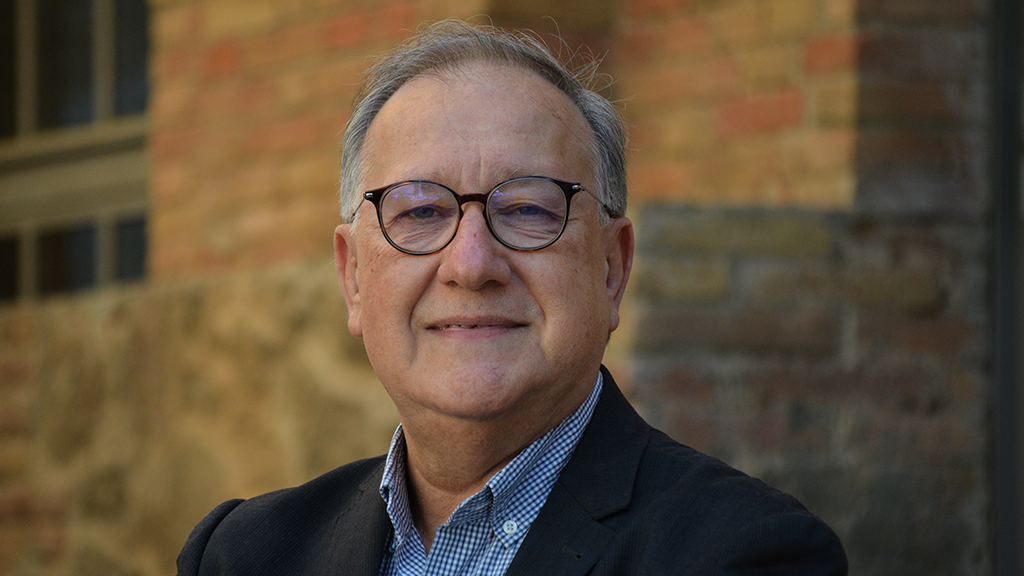
That ‘Neanderthal hashtag’ is the first media fossil, according to Carlos Alberto Scolari, a specialist in digital media and language and a lecturer at Pompeu Fabra University in Barcelona. He has devoted his entire life to understanding the media and cultural evolution of communication and has set out his work in the book Homo mediaticus. A History of Humanity: From the ‘Neanderthal hashtag’ to the iPod (Ariel).
Media fossils
And what is a media fossil? “It is an old communication device or support that, although no longer in use, was put to good use by our ancestors,” explains Scolari. He does so in this video interview via Zoom from Barcelona, using a computer which, indeed, will one day be a media fossil itself.
This is the universe that the Argentine expert has explored and distilled into twenty-five chapters, each centred on a different piece from every era. Through them, he creates a mosaic of the history of language and its many forms, in which different media engage in dialogue, overlap and endure.
It is a journey through elements such as La Cueva de las Manos, the Caylus Vase, the quipu, the Mayan Codex, Diderot’s Encyclopédie, the daguerreotype, the fax machine, the Walkman and the iPod. Each of these pieces has its own story; each portrays the humanity of its era and opens a window onto our past, helping us to understand where we come from. They remind us that language is what distinguishes human beings from other species and that it is our systems of communication that have enabled us to progress to where we are today.
Because, as Scolari argues, if we can trace the history of life on Earth through its archaeological fossils, “why not trace the evolution of Homo sapiens through its technologies? And why not tell the story of humanity through its methods of communication?”
And these technological pieces, contrary to popular belief, do not disappear; they are like matter: they transform. Carlos Alberto Scolari explains that we are used to being told that the history of communication follows a single timeline, and he proposes a different perspective:
“First there were clay tablets, then came papyrus, then parchment, then Gutenberg, then the printing press, the telegraph, photography, cinema, radio, television and the internet.
They tell you that television arrived, but they don’t tell you what happened to the radio. Or they say: ‘Digital music has arrived.’ But what happened to the old music formats? Or when the printing press arrived, what happened to those who copied books in the fifteenth century or throughout the Middle Ages? I like to think of the evolution of the entire media ecosystem as a vast network. Not as a timeline.”
The history of the media can also be seen not as a succession of inventions, but as a conversation that spans the centuries.
Communication is a network
Scolari’s perspective is similar to that of certain artists who believe that, in the arts, there is no evolution as such, nor is every new work or artist better than the previous one, because that would imply, for example, that a poet of today is better than Shakespeare. They conceive of the arts as a dimension where time does not exist and all creations coexist and engage in dialogue simultaneously, enriching and learning from one another. This is how each art form is merely a reflection of its own era.
The idea behind Homo mediaticus, explains Scolari, “is precisely to connect things. When one researches the history of the media, one sees certain moves – or tricks, one might say – by Thomas Alva Edison, which were highly commercial, and how, a century later, Bill Gates does exactly the same thing. So, one begins to piece things together and, rather than arriving at a single direction, one finds a vast spider web that changes and evolves over the years”.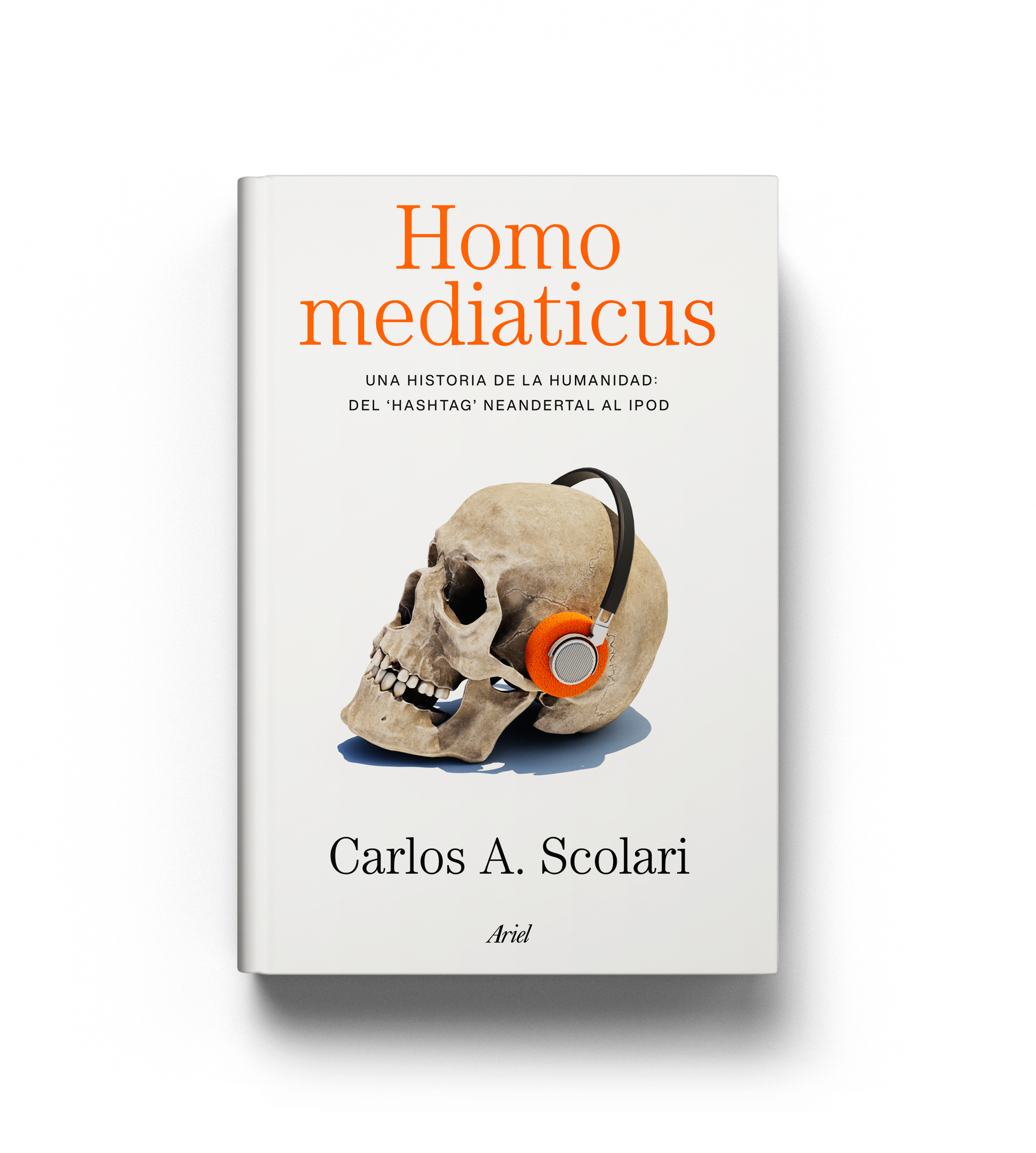
It is a very contemporary approach in which interdisciplinarity is key. This essay invites us to make connections between the past and the present. The historical period most similar to the present in terms of the cascade of inventions, their capacity to surprise and to alter and incorporate habits and paradigm shifts, is the late nineteenth century—the era of the First Industrial Revolution—says Scolari:
“The most interesting, richest period is well into the nineteenth century. Because in 1837 we had the telegraph, in 1840 photography, in 1870 the kinetoscope—that device Edison had created for watching films individually—and we also had Edison’s cylinders for recording music. We had the first film screening in 1895.
By that time, between 1870 and 1880, telegraph lines had reached Australia and New Zealand. The British Empire had cabled the entire planet. The telegraph reached everywhere. It was incredible. By the end of the nineteenth century, all of this was fully established and up and running.”
This is when a key player came into the picture, ushering in a shift towards the collective: the print media underwent significant development. There was a clash between the media empires of Hearst and Pulitzer. It was then, the expert insists, “in the second half of the nineteenth century that there was a proliferation of new forms of communication similar to what we are seeing today”.
Another crucial moment is the interwar period, from 1920 to 1939: cinemas took the world by storm, radio became widespread, music diversified and found its way into homes and offices. Television was born, but it was refined and became widespread after the Second World War, just like the telephone. It was the eve of the future.
Has the age of oral communication arrived?
Today, humanity has reached a point where the various forms of language and communication are expanding through new individual and collective technologies. It began with the popularisation of the internet, following the creation of the World Wide Web in 1989, which has driven the dual world of analogue and digital, accelerated its pace, and transformed the way in which people acquire and disseminate knowledge and entertainment, and the way they interact and communicate with one another.
Such is the transformative power of this dual world that there are experts and philosophers who argue that the Gutenberg era is drawing to a close and that we are witnessing the birth of the oral era, driven by audiovisual media and shifts in communication. A very interesting debate with an unpredictable outcome, according to Carlos Alberto Scolari:
“Walter Ong, who was a disciple of Marshall McLuhan, speaks of a ‘secondary orality’. He said: ‘Orality was one thing six, seven, eight or ten thousand years ago, when people spoke but did not come from a culture in which writing existed; today’s orality is something quite different’”.
And the expert cites this very moment of the video interview as an example:
“Because this conversation, this interview we are conducting, I think of it in terms of writing, and to that end I structure my speech and phrases as if I were writing them with my mouth. We are both doing this. This is what Walter Ong calls ‘secondary orality’; it is now a ‘post-writing orality’.”
So, what is happening?, the expert asks himself, and answers:
“We are witnessing the rise of audiovisual discourse. Perhaps today it is writing that is being transformed by all these new forms of orality and visualisation. Some speak of ‘digital orality’, which would be this whole communicative magma we have today.
After five centuries, the Gutenberg galaxy has come to an end, as McLuhan put it. And is the Turing galaxy beginning, marked by computing and artificial intelligence? It’s far too early to say.”
The expert is cautious and backs up his view by pointing out that we still live surrounded by books. Never before have so many been published: in the United Kingdom more than 153,000 a year, in Italy around 140,000 a year, and in Spain almost 96,000 a year.
Not to mention that the latest report from the Spanish Federation of Publishers’ Associations reveals that those under 24 are the age group that reads the most: 78 per cent. Young people seem to find in these works a kind of oasis amidst a world of screens and digital overstimulation.
So, Scolari insists: “To declare the Gutenberg galaxy—or written culture—dead seems premature to me. I don’t believe that process is taking place. What we have is a coexistence of different communication systems in tension, each reshaping the other.”
The second one of AI
And this is where the penultimate major player in this story comes in: artificial intelligence. A technology that is barely in the first second of its existence and is already changing the way we write, think and communicate, explains the expert:
“We write differently today as a result of our interactions with ChatGPT, Gemini and all these systems. And we’re going to write differently. It’s fascinating to see how, in the nineteenth century, our perspective changed because of photography. If you go to a museum with paintings from the nineteenth and twentieth centuries, it’s crystal clear which were painted before or after the advent of photography. From the way they’re framed, from the painter’s perspective, you can tell which ones are from the late nineteenth century, because they incorporated photographic perspectives. And that’s when you realise how a media had transformed the painters’ perspective in that case. Now we have so many media and forms of communication that these processes are becoming more complex.”
Amidst all these changes, the world is undergoing a transition from the Fourth Revolution – that of digitalisation, robotics and AI – towards the Fifth Revolution, which seeks to reconcile and balance technology in order to restore human beings to the centre of progress and sustainability. To achieve this, it seeks to imbue this era with what is known as ‘techno-humanism’.
All are echoes of the Neanderthal hashtag bequeathed by the human species that did not survive; a symbol whose meaning at the time is unknown—we only know that it was a form of communication. Today, it can be interpreted poetically as a mysterious message left for its relative, Homo sapiens, of the future.
In ancient Rome, it was already in use – without any knowledge of Gorham’s Cave – as an abbreviation for weight in pounds. Its meanings have varied over the centuries; the most universal was as a numeral, until it was incorporated into the digital world as a symbol of unification or a tag for topics or conversations.
And there it remains, with many names, because language – like the media and communication – never disappears: it merely transforms.
Winston Manrique Sabogal is the founding editor of WMagazín, a contributor to the Spanish daily El País, where he worked for 19 years, and the author of the book The Great Transformation: Beauty, Love, Sex and Happiness in the 21st Century (Galaxia Gutenberg).
Related Trends
DAS & Small Cells


More infrastructure, more data

Global
What happened at WRC23?
Opinion
An overview of MWC 2023

