


Success Case
PODIUM – Connected, cooperative and automated mobility (CCAM)
Latest Innovations


PoDIUM (full name Physical and Digital Infrastructure (PDI) connectivity and cooperation enablers building trust and sustainability for CCAM) aims to address these challenges to reach higher levels of vehicle automation and foster the development of advanced Connected, Cooperative and Automated Mobility (CCAM) solutions. The project defines a series of demanding CCAM use cases to identify and assess connectivity and cooperation enablers and needs to advance key technologies both in the physical and digital part of the infrastructure. PoDIUM will conduct demonstrations of the use cases in real-life conditions in three Living Labs in Germany, Italy and Spain, in urban, highway and crossborder environments.
The project brought together 26 partners from 8 European countries, fostering innovation and ensuring that solutions are scalable and interoperable.
For Cellnex PoDIUM Project demonstrates how robust telecom infrastructure—such as towers, small cells, fiber backhaul, and edge computing—enables seamless communication between vehicles, roadside units (RSUs), and cloud platforms. A key highlight is the deployment of Vehicle-to-Everything (V2X) technology, powered by 5G, which transforms roads into intelligent ecosystems where vehicles, infrastructure, and cloud platforms exchange data in real time.
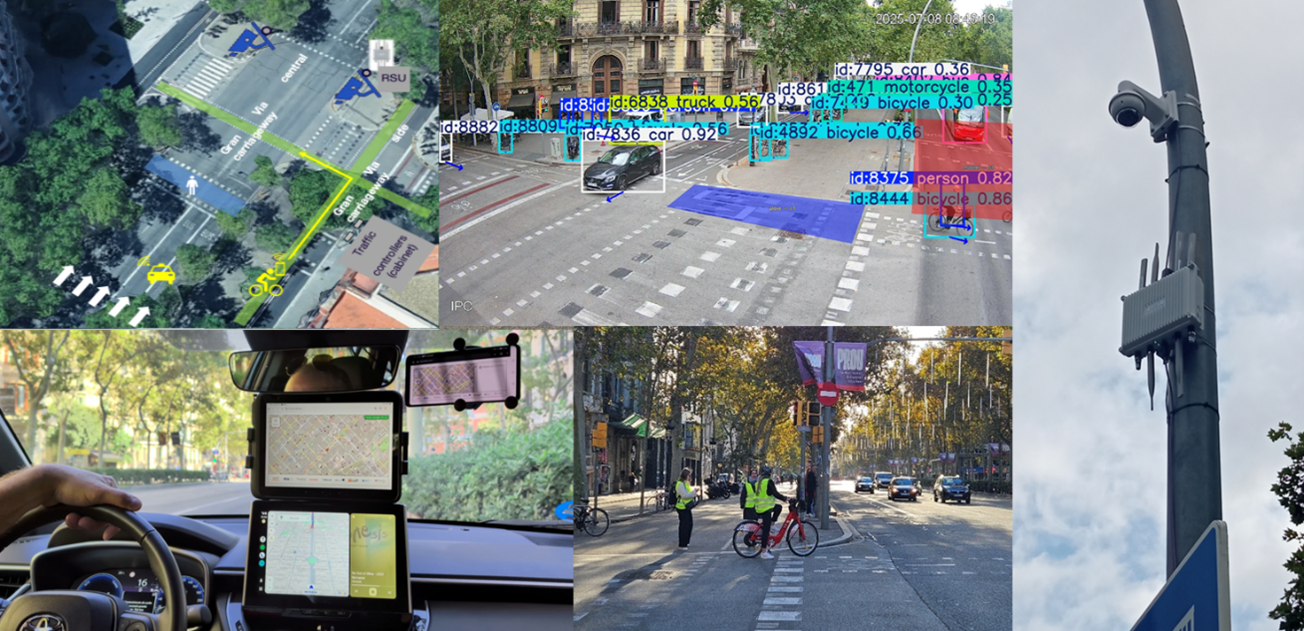
Barcelona served as a major testbed, combining dense urban traffic with interregional corridors. Two main use cases were validated:
- Urban Innovation on Gran Via: Real-time data exchange improved emergency response times, enabled smarter traffic management, and enhanced pedestrian safety through AI-powered alerts.
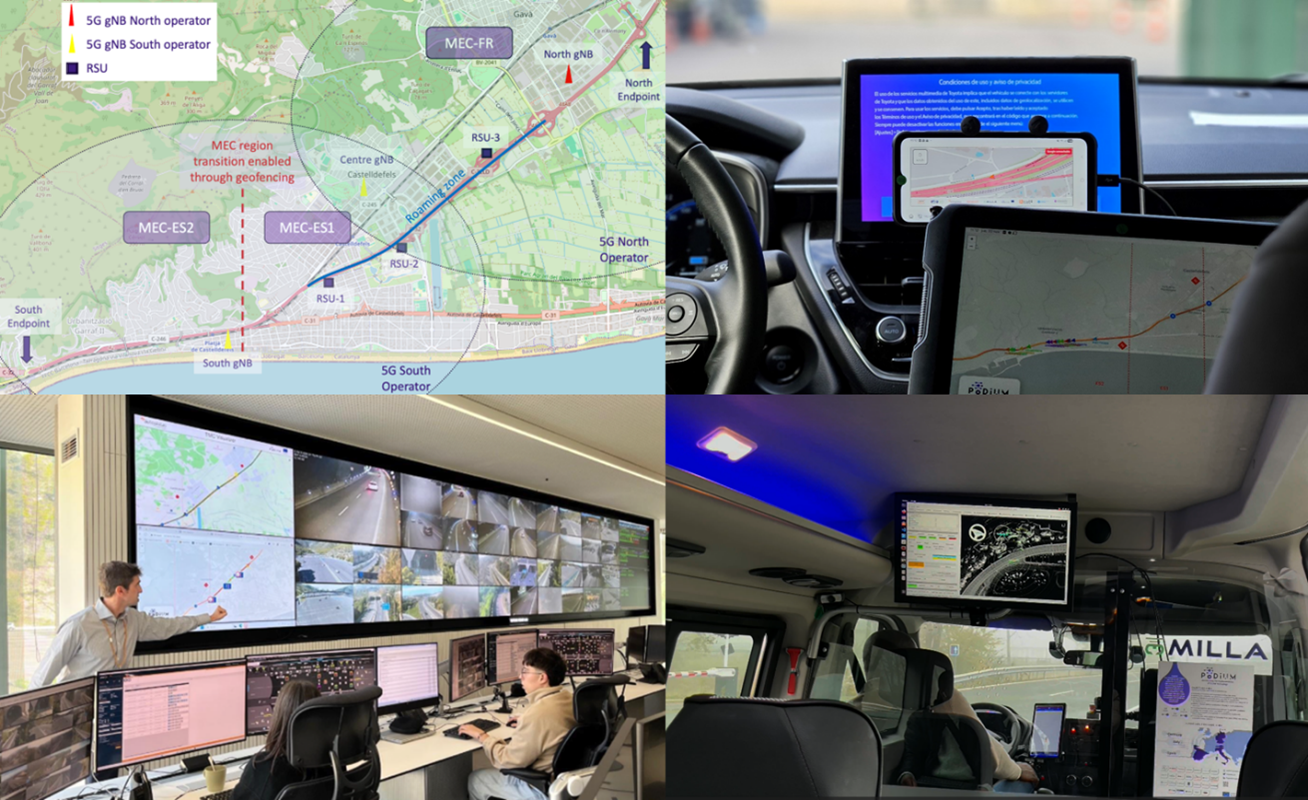
- Cross-Border Connectivity: On the highway between Spain and France, vehicles maintained seamless connectivity while switching between mobile operators, supported by RSUs and 5G networks. Autonomous shuttles demonstrated cooperative driving, reacting to traffic strategies and safety alerts without human intervention.

Challenges
Seamless Cross-Border Communication: Ensuring uninterrupted connectivity as vehicles move between different mobile operators and national borders is complex. The infrastructure must support handovers without data loss or latency spikes.
Dense Network Deployment: Reliable CCAM services require dense, high-availability networks along transport corridors, which involves significant investment and coordination among stakeholders.
Interoperability: Achieving interoperability between different telecom operators, automotive manufacturers, and technology platforms is essential for consistent service delivery, especially in cross-border scenarios.
Real-Time Responsiveness: Applications like collision avoidance and adaptive speed recommendations demand ultra-low latency and high bandwidth, which can be challenging to guarantee in all environments.
Stakeholder Collaboration: Building resilient, multi-tenant infrastructure requires close collaboration between public authorities, telecom operators, and technology partners.
Solution
Robust Telecom Infrastructure: The project deployed 5G towers, fiber backhaul, and RSUs along key corridors, enabling high-speed, low-latency communication for vehicles and infrastructure.
Multi-Tenant and Interoperable Networks: By leveraging neutral-host infrastructure providers like Cellnex, the solution supports multiple operators and seamless handovers, even across borders.
Integration of Advanced Technologies: The use of 5G, edge computing, and IoT creates a foundation for predictive traffic management, adaptive tolling, and real-time safety alerts.
Real-World Validation: Extensive testing in Living Labs (Ulm, Turin, Barcelona) demonstrated the effectiveness of the solution in diverse environments, from urban centers to international highways.

Related Use Cases


Latest news








Cellnex Trends
Technology


Digital radio that prioritises plurality

Broadcast
Pioneers in ultra high-quality on DTT
DAS & Small Cells
More infrastructure, more data
